
Cold Outreach KPIs That Matter
Cold Outreach KPIs That Matter is not a trick or a one-line template. It is an operating decision inside cold outreach strategy: who to target, what to research, which tools to trust, how to stay respectful, and how to turn a first touch into a measurable commercial conversation.
Measure clean delivery, qualified replies, meetings, opportunity quality, and revenue instead of vanity activity. A practical guide for commercial operators building a responsible outbound workflow.
On this page
Context
What problem is cold outreach KPIs really trying to solve?
Measure clean delivery, qualified replies, meetings, opportunity quality, and revenue instead of vanity activity. That is the practical reason people search for cold outreach KPIs: they are usually trying to make a commercial outreach decision without damaging trust, wasting data, or buying yet another disconnected tool. A useful answer has to explain the operating choice, not just hand over a short checklist.
GhostReach writes for commercial operators who need email, SMS, calls, voicemail, and follow-up to act like one coordinated workflow. In a real sales motion where prospects move across channels and a reply in one place should change what happens everywhere else, buyers rarely reward raw volume. They reward clarity, timing, and evidence that the sender understands their world. A serious article on outbound metrics should help the reader make better decisions before launch, while still giving enough practical detail to act.
Google's people-first content guidance is a useful editorial mirror here. The article should be valuable even if a search engine never existed. For outreach, the same principle applies to the recipient: the message should be useful enough to recognize, not merely automated enough to send.

Reader intent
What should you know before acting on cold outreach kpis that matter?
Before choosing software or copy, write the operating question in plain language: which channel is appropriate for this buyer, what context should each touch add, and when should the cadence stop. This forces the campaign to become specific. A campaign aimed at every local business in a city cannot learn much. A campaign aimed at one category, one service problem, one buyer role, and one territory can produce signals you can interpret.
For Cold Outreach KPIs That Matter, the first draft should define the market, the disqualifiers, the contact path, the message promise, and the stop rules. The stop rules matter. A prospect who opts out, replies with a wrong-person note, or shows no fit should change the record. A healthy outreach process learns from those signals instead of pushing every record through the same sequence.
This planning step also protects the article from becoming generic. If the campaign, template, comparison, or buying guide cannot name the audience and the reason for contact, the reader will feel the gap. People-first SEO and responsible outreach share the same discipline: be useful because the subject deserves usefulness.
- Pick the channel mix from buyer context, not from what is easiest to automate.
- Keep every touch tied to the same account record and campaign objective.
- Stop or change cadence when opt-outs, complaints, or bad-fit replies rise.
Research
How should you research the market before cold outreach kpis that matter?
Strong outreach starts before the first sentence. For this topic, research means you map buyer urgency, contact preferences, business hours, previous engagement, and the strength of your reason for reaching out. That work may feel slower than exporting a broad list, but it prevents the most expensive mistakes: irrelevant prospects, stale contacts, vague copy, and a sender reputation problem that could have been avoided with a better filter.
A practical research pass should capture the account name, website, category, location, decision context, source URL, contact confidence, and reason the account belongs in the campaign. If the prospect is local, you may also care about service area, property type, recent activity, hiring signals, reviews, or obvious vendor gaps. Every field should help you decide whether to send or how to write.
Do not confuse data quantity with list readiness. A thousand scraped rows can be less valuable than one hundred accounts with clear fit, valid contact paths, and a message that matches the buyer's world. If you cannot explain why a record belongs in the campaign, it probably needs more research or it needs to be removed before launch.
Deep research lens
What research details make cold outreach kpis that matter worth reading?
A useful article on Cold Outreach KPIs That Matter should not sound interchangeable with every other outreach guide. The research should look for qualified reply, bounce pattern, meeting quality, pipeline source, objection theme, segment performance, and source-to-reply rate. Those are the details that change the advice, the examples, the tool choice, and the warning signs a reader should notice before acting.
The second layer is operational: qualified meeting, deal quality, opt-out concentration, pipeline value, cost per conversation, GhostReach role, and HubSpot role. These are not keyword decorations. They become fields in the lead list, checks in the launch review, questions in the buying process, or signals that tell the team to pause before sending. If the article cannot connect those details to a decision, it is not deep enough.
For cold outreach kpis that matter, the most useful click is the one that saves the reader from a bad campaign. That might mean narrowing a list, choosing a different channel, rewriting a claim, checking a vendor page, or realizing the campaign should wait until the data is cleaner.
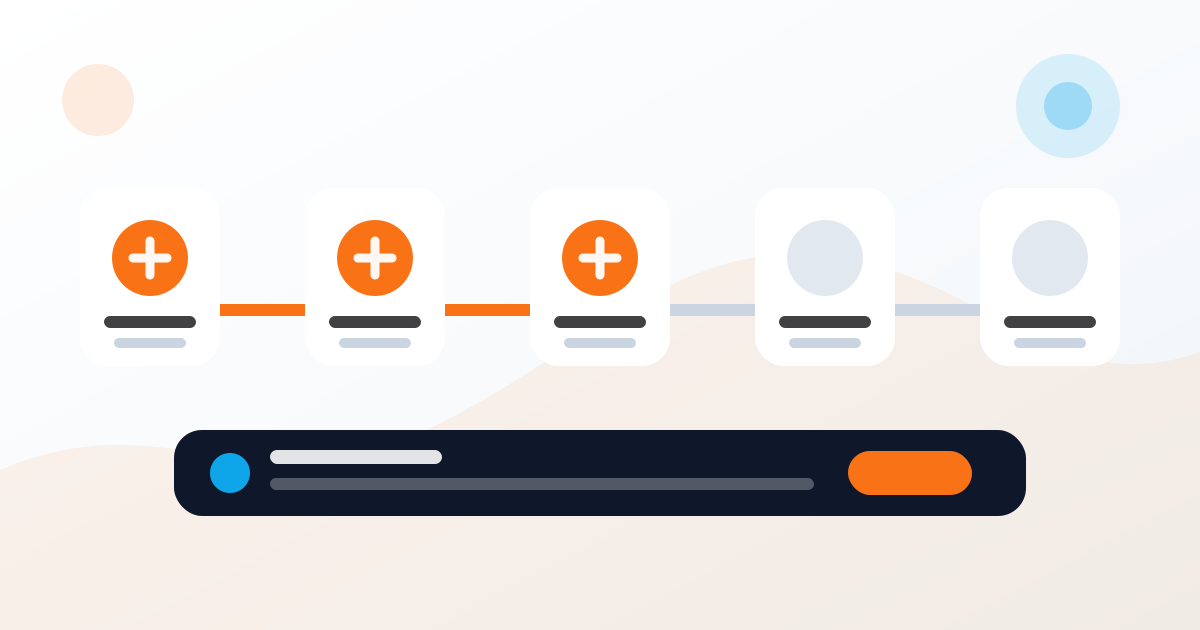
This is also why each GhostReach guide includes sources and visuals. The source links let readers verify current guidance. The visuals give them a mental model for how research, refinement, outreach, and replies connect rather than leaving the article as a wall of advice.
List quality
How should the list and message work together for cold outreach kpis that matter?
The list is not separate from the message. The fields you collect determine what the email, SMS, call, or voicemail can responsibly say. For Cold Outreach KPIs That Matter, use the list lens this way: group accounts by fit, urgency, geography, and available contact paths so the cadence can adapt instead of blasting everyone the same way. When the data and copy are built together, personalization becomes evidence of fit rather than a decorative first line.
A good record should make the next step obvious. If the account is a fit but the contact path is weak, the action may be enrichment or verification. If the contact path is strong but the business is outside your service area, the action is removal. If the account is a fit and the timing signal is strong, the message can be more direct because it is grounded in a real reason to reach out.
This is also where many teams should pause. If too many records need manual repair, that is not a sign to push harder. It is a sign to tighten the search query, change the source, or add a review step. Campaign speed is useful only after the inputs are trustworthy enough to send.
Channel map
Which channels belong in cold outreach kpis that matter?
A multichannel strategy should not mean every prospect receives every touch. Email, SMS, calls, voicemail, and social touches each carry different expectations. The right channel depends on urgency, relationship, permission, buyer workflow, and how strong the reason for contact is.
For Cold Outreach KPIs That Matter, map channels to account states. New cold accounts may start with email. Accounts that replied or requested a call may move to phone. SMS and voicemail need extra care around consent, opt-outs, carrier registration, and recordkeeping. The channel mix should earn trust, not overwhelm the buyer.
Every channel should share one account record. If a prospect replies to email, the call plan should change. If a number opts out, SMS should stop. If a voicemail receives no response, the next email should not pretend nothing happened.
Cadence
How do you build a cadence that adds context?
A good cadence changes the reason for the message across touches. The first touch introduces relevance. The second adds a practical detail. The third may ask for the right owner. The final touch closes the loop. The cadence should feel like a conversation trying to happen, not a machine trying to win.
Spacing matters because buyers have their own timing. Too much pressure creates complaints and opt-outs. Too little follow-up leaves interested prospects behind. The right answer depends on deal size, urgency, market familiarity, and channel sensitivity.
Use Cold Outreach KPIs That Matter to define what each touch must accomplish. If two touches have the same purpose, cut one or rewrite it. Every touch should make the buyer more informed or make the team's next action clearer.
Reply handling
What should happen when a prospect responds?
A reply is a handoff from automation to judgment. Interested replies need quick human follow-up. Not-now replies need a future task. Wrong-person replies need routing. Objections need a concise answer. Opt-outs need immediate suppression.
The campaign should pause the account when a meaningful reply arrives. Continuing to send a sequence while someone is already engaging is one of the fastest ways to make outreach feel careless.
Reply handling is where many outreach systems leak value. The list and message may do their job, but the team still loses the opportunity if the next step is slow, unclear, or disconnected from the original context.
Tools
Which tools and sources should you verify for cold outreach kpis that matter?
Tools that may help with this workflow include GhostReach, HubSpot, Pipedrive, Airtable, Google Sheets, and Slack. They are not listed as a permanent ranking because pricing, features, policy requirements, and data coverage change. Use them as categories to investigate: discovery, enrichment, validation, sequencing, phone workflows, reply management, and reporting. The right stack is the one that makes the actual work easier to operate and easier to audit.
A simple way to compare tools is to ask what each one owns. Does it create the lead record, enrich contact fields, verify emails, send the sequence, manage replies, record opt-outs, or measure pipeline? If a tool does only one slice, that can still be valuable. The danger is assuming one slice means the whole workflow is handled.
The research base for this guide uses current official or primary sources where possible: Google Search Central: helpful, reliable, people-first content, Google Search Central: spam policies, FTC: CAN-SPAM Act compliance guide, HubSpot official product page, and Pipedrive official product page. That matters because outreach advice becomes stale quickly. Vendor feature pages, carrier rules, legal guidance, and Google quality guidance all change, so this article avoids frozen pricing claims and focuses on decisions a reader can verify.
For tool mentions, the practical research question is what each product actually owns in the workflow. HubSpot and Pipedrive are linked as source material so readers can check whether the tool currently handles discovery, enrichment, validation, sending, phone workflows, reply management, analytics, or compliance records. A useful blog post should make that verification easier rather than pretending the market is static.
The strongest source is often the prospect data itself: websites, business categories, locations, reviews, service pages, contact paths, and replies. Treat those records as evidence. If the evidence does not support the audience, message, or channel, the campaign is not ready to scale.
Quality control
Which mistakes should you fix first in cold outreach kpis that matter?
Most campaigns do not fail because one subject line was imperfect. They fail because the audience was too broad, the data was not reviewed, the message did not match the buyer, or the team kept sending after the market gave negative feedback. The mistakes below are common because they happen quietly while everyone is focused on launch volume.
Treat these as preflight checks rather than postmortem notes. If you catch them before the campaign starts, you protect deliverability, brand trust, and the team's time. If you wait until after complaints or poor replies arrive, the fix is usually slower because you have to repair both the process and the reputation signal. The biggest risk for this topic is adding channels to increase pressure instead of increasing usefulness, especially when consent or carrier requirements are unclear.
- Adding channels before the offer and list are clear.
- Repeating the same message in every touch.
- Letting replies sit while the campaign keeps sending.
Compliance
What responsible outreach notes matter?
This guide is informational and educational, not legal advice. Outreach requirements vary by jurisdiction, audience, message type, consent posture, source of data, and the exact technology used to send. Treat this section as a practical operating lens, then confirm your own obligations with qualified counsel before you scale.
For commercial email, the FTC CAN-SPAM guide is the starting point GhostReach cites for U.S. teams. Review sender identity, truthful subject lines, honest header information, a valid physical postal address, and a working opt-out process before sending any campaign. The spirit of the rule is simple: do not make the recipient guess who you are, why you wrote, or how to stop future messages.
When in doubt, slow down. A smaller campaign that can explain its source data, audience logic, message claims, and stop conditions is more durable than a large campaign that only looks efficient on a dashboard.
For this article, the source list includes Google Search Central: helpful, reliable, people-first content, Google Search Central: spam policies, FTC: CAN-SPAM Act compliance guide, HubSpot official product page, and Pipedrive official product page. Use those references as starting points for current guidance, especially when the campaign touches commercial email, SMS, calls, voicemail, carrier registration, scraped data, or scaled content decisions. Source links are included on this page so readers can review the original guidance rather than relying on a paraphrase.
Measurement
How do you measure whether cold outreach kpis that matter worked?
Measurement should match the workflow, not just the sender dashboard. For this topic, focus on channel-level replies, time to follow up, booked meetings, opt-outs, handoffs, and whether later touches create better context. Open rates and activity counts can provide context, but they should not become the scoreboard. A campaign that produces fewer sends and better qualified conversations is often healthier than a high-volume campaign with vague engagement.
Review the qualitative signals too. Are replies confused or specific? Are prospects asking for timing, pricing, referral, or proof? Are opt-outs concentrated in one source, one message, or one channel? Those patterns tell you whether the issue is targeting, research, copy, offer, or follow-up. The best teams treat replies as market research, not just as sales outcomes.
Set a review rhythm before launch. Daily checks catch urgent replies and suppression needs. Weekly checks reveal whether the niche, tool stack, and message are working. A 30-day view is usually enough to decide whether to scale, rewrite, change data sources, or pause. The point is not to prove the campaign was perfect. The point is to learn fast without over-sending.
GhostReach
Where GhostReach fits
GhostReach is built for commercial operators who want the research, refinement, message setup, launch controls, and reply workflow in one coordinated place. It is not a promise that every campaign will work. It is a system for doing the work with better inputs, clearer steps, and fewer disconnected tools.
If you would rather avoid stitching together lead scraping, validation, cold email, SMS, ringless voicemail, Instagram warming, and calling tools, GhostReach can help run the same operating pattern from one workspace. Use the article above as the strategy, then let GhostReach handle the practical movement from researched accounts to responsible outreach.
Frequently asked questions
What is the first step in cold outreach KPIs?
Start by narrowing the audience and the reason for contact. For cold outreach kpis that matter, define the buyer, territory, disqualifiers, source data, channel fit, and next step before writing copy or importing leads into a sending tool.
Which tools are useful for cold outreach kpis that matter?
GhostReach, HubSpot, Pipedrive, and Airtable can help, depending on the workflow. Compare tools by the job they perform: discovery, enrichment, validation, sequencing, phone workflows, reply management, reporting, or compliance records. Verify current limits and policies directly with vendors.
How do you know if cold outreach KPIs is working?
Measure channel-level replies, time to follow up, booked meetings, opt-outs, handoffs, and whether later touches create better context. Activity counts matter less than qualified conversations and clear learning. If replies show poor fit, weak timing, or channel discomfort, treat that as campaign research and adjust before increasing volume.
Where does GhostReach fit into this workflow?
GhostReach helps commercial operators connect research, list cleanup, message setup, launch controls, and reply workflows. It is useful when the team wants fewer disconnected tools and a more coordinated way to move from researched accounts to outreach.