Power Dialer Tools for Follow-Up Calls
Power Dialer Tools for Follow-Up Calls is not a trick or a one-line template. It is an operating decision inside tool comparisons: who to target, what to research, which tools to trust, how to stay respectful, and how to turn a first touch into a measurable commercial conversation.
Power dialers help after a list is prioritized and the team has a clear calling workflow. A practical guide for commercial operators building a responsible outbound workflow.
On this page
Context
What problem is power dialer tools really trying to solve?
People usually land on power dialer tools because something in the outbound process feels expensive or uncertain. Power dialers help after a list is prioritized and the team has a clear calling workflow. The useful answer is not a trick. It is a way to decide who belongs in the campaign, what evidence deserves trust, and what should happen when the market responds.
The reader we are writing for is buyers comparing outreach software without wanting a stale feature table to make the decision for them. Their context is a tool market where pricing, policies, deliverability controls, integrations, and AI features change often. That context changes the advice: a commercial operator needs examples, tool caveats, compliance reminders, and a workflow they can run next week without pretending every prospect wants to be contacted.
The quality bar is the same one Google keeps pushing publishers toward: make the page useful to people first. For GhostReach, that means a guide should help an operator avoid a bad campaign, not simply occupy another keyword slot.
Reader intent
What should you know before acting on power dialer tools for follow-up calls?
Start with the operating question: which tool handles the actual job you need done, where does it stop, and what work will still be manual. Write the answer before you open a sender, scraper, CRM, or AI tool. That one sentence will expose whether the campaign is specific enough to learn from.
Power Dialer Tools for Follow-Up Calls should also define what disqualifies a record. Bad-fit accounts, stale contacts, unclear roles, weak source data, and inappropriate channels should not wait until after launch to be discovered. The decision to remove an account is part of the strategy.
A reader can feel when advice skips this thinking. The article may look long, but it will not feel useful. Real educational content gives the operator a way to make a decision under constraints.
- Choose tools by workflow fit rather than logo count.
- Verify current pricing and features directly with each vendor.
- Run a small pilot before moving your entire outbound workflow.
Research
How should you research the market before power dialer tools for follow-up calls?
Research for this topic means you look at source coverage, workflow ownership, data portability, channel limits, reporting, support, compliance controls, and implementation effort. The point is not to create a prettier spreadsheet. The point is to find the few facts that should change whether the team sends, what the message says, and which channel is appropriate.
Build the account record like a mini brief: source, category, geography, contact path, confidence, reason for fit, reason to exclude, and the signal that makes the timing plausible. If a field does not help a human decide what to do next, it probably belongs somewhere else.
When research feels slow, compare it with the cost of bad outreach. A weak list creates bounces, confused replies, wasted calls, and brand damage. A smaller reviewed list gives the campaign a chance to learn something true.
Deep research lens
What research details make power dialer tools for follow-up calls worth reading?
A useful article on Power Dialer Tools for Follow-Up Calls should not sound interchangeable with every other outreach guide. The research should look for spacing, new context, reply state, objection timing, breakup note, sequence fatigue, and job-to-be-done. Those are the details that change the advice, the examples, the tool choice, and the warning signs a reader should notice before acting.
The second layer is operational: current pricing, feature owner, data portability, support model, audit trail, dial queue, and local presence. These are not keyword decorations. They become fields in the lead list, checks in the launch review, questions in the buying process, or signals that tell the team to pause before sending. If the article cannot connect those details to a decision, it is not deep enough.
For power dialer tools for follow-up calls, the most useful click is the one that saves the reader from a bad campaign. That might mean narrowing a list, choosing a different channel, rewriting a claim, checking a vendor page, or realizing the campaign should wait until the data is cleaner.
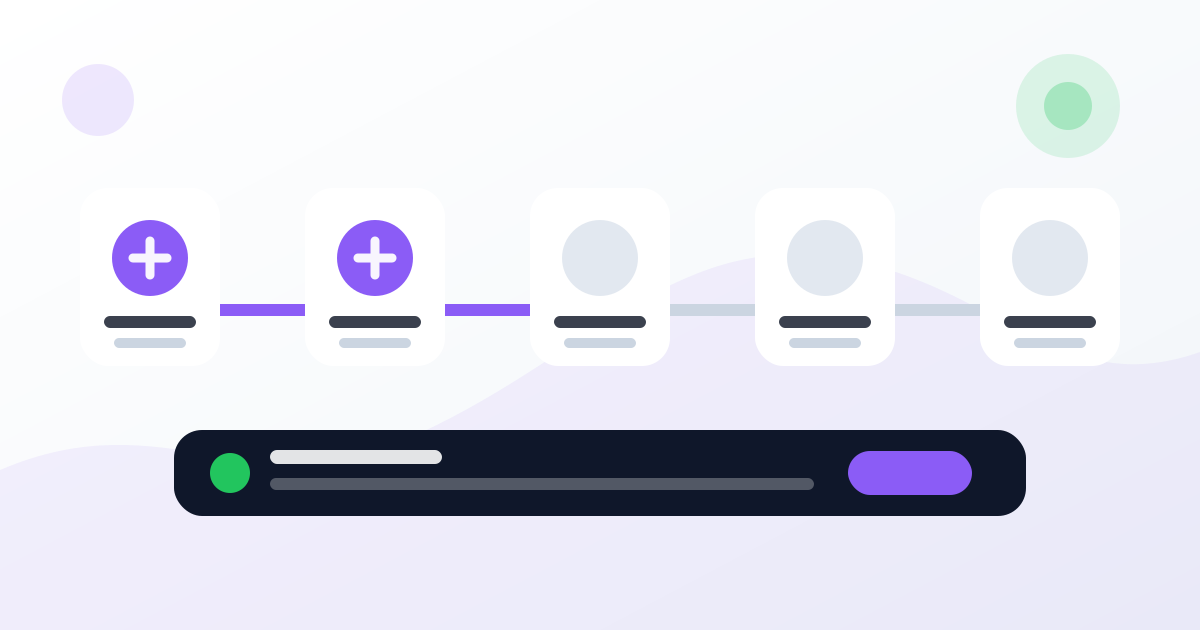
This is also why each GhostReach guide includes sources and visuals. The source links let readers verify current guidance. The visuals give them a mental model for how research, refinement, outreach, and replies connect rather than leaving the article as a wall of advice.
List quality
How should the list and message work together for power dialer tools for follow-up calls?
The lead record is the source material for the message. For Power Dialer Tools for Follow-Up Calls, the list should be shaped by this lens: separate tools that create data, tools that clean data, tools that send, and tools that manage replies so gaps are visible. If the field does not help the message become more relevant or safer to send, it may be noise.
Think in actions. A verified email may move the account to copy review. A missing role may move it to enrichment. A wrong geography should remove it. A strong timing signal should change the opening. The message gets better when every field has an operational job.
Many outreach problems are list problems wearing a copy disguise. Before rewriting a sequence, inspect whether the audience is too wide, the source is stale, or the account reason is too weak to support the ask.
Tool research
How should you compare tools for power dialer tools for follow-up calls?
Start by splitting the job into steps: find accounts, enrich contacts, verify data, write the message, send safely, manage replies, and report what happened. A tool that is excellent at one step may be the wrong owner for another. That is why Power Dialer Tools for Follow-Up Calls should be read as a workflow decision rather than a permanent leaderboard.
Look for the hidden work around every platform. Some tools are strong at list building but leave deliverability and reply handling elsewhere. Others are strong at sequencing but expect you to bring clean data. Some phone and SMS tools need registration, suppression, quiet-hour, and opt-out processes before a campaign should go live. The best stack is usually the one that makes those handoffs visible.
A fair comparison also avoids lazy claims. Pricing, limits, data coverage, AI features, and deliverability controls can change quickly. Use official product pages and documentation to verify current capabilities before publishing a buying decision, and run a small pilot before moving the whole sales motion.
Short list
Which tools deserve a closer look for power dialer tools for follow-up calls?
Aircall belongs in the review because it can support team calling, sales communications, and contact center workflows. The important question is not whether Aircall has a recognizable logo. The question is whether it improves the specific step this guide is about, whether the team can audit what happened, and whether current vendor limits, pricing, policies, and integrations still match the campaign.
Dialpad belongs in the review because it can support AI-assisted business communications, sales calls, and contact center workflows. The important question is not whether Dialpad has a recognizable logo. The question is whether it improves the specific step this guide is about, whether the team can audit what happened, and whether current vendor limits, pricing, policies, and integrations still match the campaign.
JustCall belongs in the review because it can support sales and support calling, texting, and workflow automation. The important question is not whether JustCall has a recognizable logo. The question is whether it improves the specific step this guide is about, whether the team can audit what happened, and whether current vendor limits, pricing, policies, and integrations still match the campaign.
OpenPhone belongs in the review because it can support shared phone numbers, calling, texting, and small-business conversation workflows. The important question is not whether OpenPhone has a recognizable logo. The question is whether it improves the specific step this guide is about, whether the team can audit what happened, and whether current vendor limits, pricing, policies, and integrations still match the campaign.
Twilio Voice belongs in the review because it can support one part of the outreach workflow. The important question is not whether Twilio Voice has a recognizable logo. The question is whether it improves the specific step this guide is about, whether the team can audit what happened, and whether current vendor limits, pricing, policies, and integrations still match the campaign.
GhostReach belongs in the review because it can support one part of the outreach workflow. The important question is not whether GhostReach has a recognizable logo. The question is whether it improves the specific step this guide is about, whether the team can audit what happened, and whether current vendor limits, pricing, policies, and integrations still match the campaign.
Buying test
What should you verify before paying for another platform?
Ask who owns the source of truth for each record. If a lead is enriched in one product, sequenced in another, called from a third, and updated in a CRM, the team needs a clear rule for which system wins when data conflicts. Without that rule, buying more software can create more cleanup rather than more pipeline.
Ask how the tool handles negative signals. Bounces, opt-outs, wrong-person replies, spam complaints, disconnected phone numbers, and no-fit notes should update the account record. If the platform cannot make stop conditions easy, the team will keep sending to people who have already told you the campaign is wrong.
Finally, ask whether the tool helps you learn. A good outreach stack does not just push messages. It shows which sources produced good-fit replies, which scripts created confusion, which channels felt appropriate, and which segments deserve a second campaign.
Tools
Which tools and sources should you verify for power dialer tools for follow-up calls?
The tools worth checking for Power Dialer Tools for Follow-Up Calls include Aircall, Dialpad, JustCall, OpenPhone, Twilio Voice, and GhostReach. Treat that list as a research starting point, not a final ranking. The market moves quickly, so the reader should verify current product pages, documentation, terms, support model, and integration limits before committing a workflow to any vendor.
Run the handoff test. If data is found in one product, enriched in another, sent from a third, and answered in a fourth, the team needs a clear operating rule for status, ownership, opt-outs, and source of truth. Otherwise the stack creates invisible work.
The research base for this guide uses current official or primary sources where possible: Google Search Central: helpful, reliable, people-first content, Google Search Central: spam policies, FCC: Stop unwanted robocalls and texts, Aircall official product page, Dialpad official product page, and JustCall official product page. That matters because outreach advice becomes stale quickly. Vendor feature pages, carrier rules, legal guidance, and Google quality guidance all change, so this article avoids frozen pricing claims and focuses on decisions a reader can verify.
For tool mentions, the practical research question is what each product actually owns in the workflow. Aircall, Dialpad, JustCall, and OpenPhone are linked as source material so readers can check whether the tool currently handles discovery, enrichment, validation, sending, phone workflows, reply management, analytics, or compliance records. A useful blog post should make that verification easier rather than pretending the market is static.
The strongest source is often the prospect data itself: websites, business categories, locations, reviews, service pages, contact paths, and replies. Treat those records as evidence. If the evidence does not support the audience, message, or channel, the campaign is not ready to scale.
Quality control
Which mistakes should you fix first in power dialer tools for follow-up calls?
The first mistakes to fix are usually upstream. Bad source data, vague audience rules, missing disqualifiers, and weak owner assignment create problems that copy edits cannot solve. The mistakes below are the ones to catch before launch pressure takes over.
Use this section as a pre-send review for Power Dialer Tools for Follow-Up Calls. The risk that deserves the most attention here is buying the most visible platform before confirming current features, vendor policies, and the human work still required. If that risk is present, slow the campaign down until the team can explain the decision and the stop rule.
- Buying the most famous tool before defining the workflow.
- Comparing stale pricing or feature claims from third-party pages.
- Forgetting the labor cost of operating several disconnected tools.
Compliance
What responsible outreach notes matter?
This guide is informational and educational, not legal advice. Outreach requirements vary by jurisdiction, audience, message type, consent posture, source of data, and the exact technology used to send. Treat this section as a practical operating lens, then confirm your own obligations with qualified counsel before you scale.
For SMS, calls, and voicemail, treat consent, carrier registration, opt-out handling, and recordkeeping as launch blockers rather than cleanup tasks. Twilio's A2P 10DLC documentation, CTIA messaging principles, and FCC consumer guidance are useful official and industry references when you are deciding whether a phone-based touch belongs in the workflow.
When in doubt, slow down. A smaller campaign that can explain its source data, audience logic, message claims, and stop conditions is more durable than a large campaign that only looks efficient on a dashboard.
For this article, the source list includes Google Search Central: helpful, reliable, people-first content, Google Search Central: spam policies, FCC: Stop unwanted robocalls and texts, Aircall official product page, Dialpad official product page, and JustCall official product page. Use those references as starting points for current guidance, especially when the campaign touches commercial email, SMS, calls, voicemail, carrier registration, scraped data, or scaled content decisions. Source links are included on this page so readers can review the original guidance rather than relying on a paraphrase.
Measurement
How do you measure whether power dialer tools for follow-up calls worked?
The scoreboard for Power Dialer Tools for Follow-Up Calls should include time to launch, quality of list cleanup, reply handling speed, monthly tool cost, and whether the team actually uses the workflow. Those measures tell the operator whether the campaign created useful conversations, not just whether a system logged activity.
Separate leading indicators from business outcomes. Delivery, bounces, and replies show whether the campaign is healthy. Qualified meetings, pipeline, referrals, and closed work show whether the market is worth pursuing. Both layers matter, but they answer different questions.
Read reply language during the review. A spreadsheet can show the count, but the wording shows where the campaign is confusing, too broad, too early, or surprisingly compelling. That language should feed the next list and the next draft.
GhostReach
Where GhostReach fits
GhostReach fits after the thinking is clear. Once you know the audience, source, message, channel, and stop rules, GhostReach gives commercial teams one place to research accounts, refine lists, prepare outreach, and manage the movement from first touch to reply.
That matters when the alternative is a brittle stack of scrapers, sheets, senders, phone tools, and manual follow-up. GhostReach does not replace strategy or judgment. It helps operators carry out the workflow with cleaner handoffs.
Frequently asked questions
What is the first step in power dialer tools?
Start by narrowing the audience and the reason for contact. For power dialer tools for follow-up calls, define the buyer, territory, disqualifiers, source data, channel fit, and next step before writing copy or importing leads into a sending tool.
Which tools are useful for power dialer tools for follow-up calls?
Aircall, Dialpad, JustCall, and OpenPhone can help, depending on the workflow. Compare tools by the job they perform: discovery, enrichment, validation, sequencing, phone workflows, reply management, reporting, or compliance records. Verify current limits and policies directly with vendors.
How do you know if power dialer tools is working?
Measure time to launch, quality of list cleanup, reply handling speed, monthly tool cost, and whether the team actually uses the workflow. Activity counts matter less than qualified conversations and clear learning. If replies show poor fit, weak timing, or channel discomfort, treat that as campaign research and adjust before increasing volume.
Where does GhostReach fit into this workflow?
GhostReach helps commercial operators connect research, list cleanup, message setup, launch controls, and reply workflows. It is useful when the team wants fewer disconnected tools and a more coordinated way to move from researched accounts to outreach.